Apple Mac mini M6 review: Small box, serious desktop
The new Mac mini can also drive upto three external displays.
Apple’s new Mac mini with M6 does not reinvent the compact desktop. It does something more useful. Apple takes an already tiny machine and gives it substantially more computing power, faster storage, stronger performance and far more emphasis on local AI.
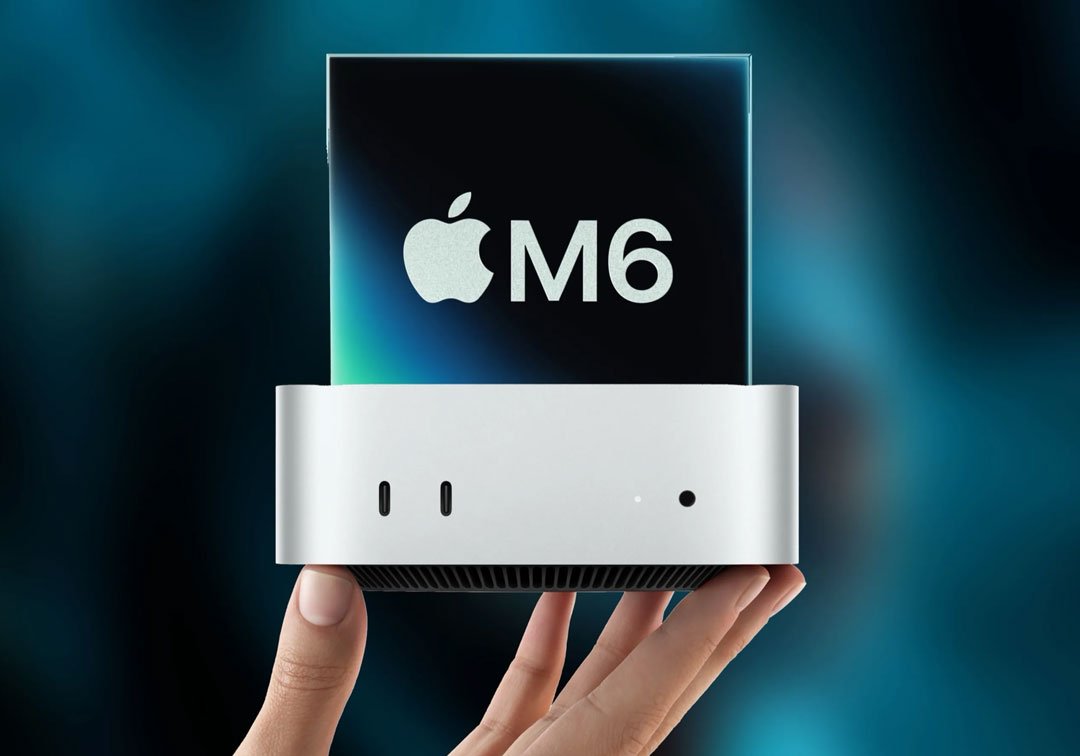
The Mac mini still measures just 5 by 5 inches and weighs about 1.5 pounds. Apple has not chased a dramatic redesign; instead, it has focused on the M6 processor.
Price starts at $899 (AED 3,799) for the M6 Mac mini in the UAE and will be available beginning September 22.
Familiar design still makes sense
Apple’s compact chassis for the Mac mini remains its biggest advantage. A 12.7cm-square desktop disappears beside a monitor. I can see it working well on a small home desk or inside a dense office setup.
There are two USB-C connections that sit at the front beside a 3.5mm headphone jack. There is an HDMI, Ethernet, and three more Thunderbolt 4 ports on the back of the mini. Apple now includes 2.5Gb Ethernet as standard, with 10Gb Ethernet available as an option.
The Mac Mini also gets Wi-Fi 7 and Bluetooth 6 with Apple’s in-house developed N1 network chip. Those changes sound insignificant compared to the new M6 processor, yet I consider them some of this generation’s most practical upgrades.
The new Mac mini can also drive upto three external displays and will support two of the three displays with upto 6K 60Hz in resolution and the third one with upto 5K 60Hz resolution through a Thunderbolt port. That is some serious flexibility for an unusually serious workstation built around Apple’s entry desktop.
M6 is where this Mac mini changes
M6 now houses a 12-core CPU and 12-core GPU with is two cores over the older M4. Plus, the GPU cores now include Neural Accelerators, and Apple adds a Dual 16-core Neural Engine.
Unified memory starts at 16GB and goes upto 32GB, with memory bandwidth ranging from 153GB/s on 16GB configurations to 170GB/s on higher-memory versions.
Apple wants users to use their Mac mini as a local AI machine. Thank you, Apple.
There is a serious jump in performance, with up to four times the AI performance, 40 per cent faster CPU performance, which translates to twice the graphics performance and twice the storage performance compared with M4.
Using LM Studio with a 14-billion-parameter, four-bit model for its AI measurements was a better way of geeting the understand what the new M6 could do. Alongside some tests on Blender, Affinity and Excel for separate workloads.
Safari, Office work, messaging, photo management and general multitasking already ran comfortably on recent Mac minis. But with the added benifits of a stronger process and to soon the be availale Siri AI, M4 owners will notice a transformation that Apple’s quotes
AI matters, but memory matters more
Running language models directly on a desktop avoids sending every workload into the cloud. Developers and enthusiasts also gain a quiet and extremely compact machine for experimentation without the need to be connected.
Maximum unified memory stops at 32GB on M6, which is more than adequate for larger models to run without problems.
I would choose 24GB or 32GB for serious local AI work, and a base 16GB machine makes more sense for conventional desktop use.
Buyers needing heavier development, sustained 3D work, or larger local models should consider the M5 Pro instead.
macOS remains part of the argument
Apple has designed the processor, operating system and media engines to run in perfect sync, which is one of the biggest advantages of using a Mac.
Creative software can tap into dedicated hardware for H.264, HEVC, ProRes and ProRes RAW work and the new M6 also includes AV1 decoding.
That tight integration gives Mac mini a serious advantage over Windows mini PCs.
Mac users already invested in iPhone integration, macOS software and Apple silicon workflows will find fewer compromises here.
Verdict
M6 Mac mini is trying to turn Apple’s smallest desktop into something usable rather than an affordable Mac for small tasks.
Apple wants to deliver one machine that delivers home computing, creative work, software development and local AI tasks in one. M6 pushes it much closer to that goal without increasing its footprint or significant cost.
I love the fact that Apple offers faster networking, front-facing USB-C ports, support for up to three displays, higher memory bandwidth and faster storage rather than some small incremental changes for the Mac Mini M6.
People will point out the slightly higher price of $899 (AED 3,799), but that could be directly linked to the global shortage and increase in chipset prices.
For someone buying a compact Mac desktop today, the M6 Mac mini looks like the sensible choice. The Mac mini M6 succeeds because Apple has not tried to make it something exotic. It is still a tiny desktop but with considerably fewer small-computer limitations.
Credits & Disclaimer: This article are credited to the Associated Press, it's authors and editors. Likewise, the images are for illustration purposes only and credited all to their respective owners. The accuracy of the article is subject from the information grabbed from the sources at the time of posting this article.